Encapsulation vs. Venting: What’s Actually Better for Crawl Spaces in the South?
If your crawl space has vents around the foundation, you’re not alone. Most homes built in the South before the last couple of decades have them. The idea made sense on paper: let outside air flow through, carry moisture out, keep the crawl space dry. What a lot of Alabama and Georgia homeowners find out the hard way is that those vents aren’t solving the moisture problem. In many cases, they’re making it worse.
Understanding why takes about five minutes, and it changes how you think about what’s actually happening under your home.
How Vented Crawl Spaces Were Designed to Work
The logic behind crawl space vents goes back decades, and at the time it wasn’t unreasonable. Builders assumed that moving air through the crawl space would carry moisture out with it, the same way opening a window dries out a damp room. Vents were placed on opposite sides of the foundation to encourage cross-ventilation, and building codes in many states required them as standard practice.
In drier climates, the approach has some merit. When the air outside is drier than the air inside the crawl space, ventilation does move moisture out. The problem is that this calculation assumes the outdoor air is the drier of the two, and in Alabama and Georgia, that assumption fails for a significant portion of the year.
The model was built around a climate it wasn’t designed for. Decades of homes went up with vented crawl spaces because that’s what the code said to do, not because anyone had tested how well it worked in high-humidity conditions over the long term. Many of those homes are now showing exactly what happens when the approach doesn’t fit the environment.
Why Venting Fails in a Hot, Humid Climate
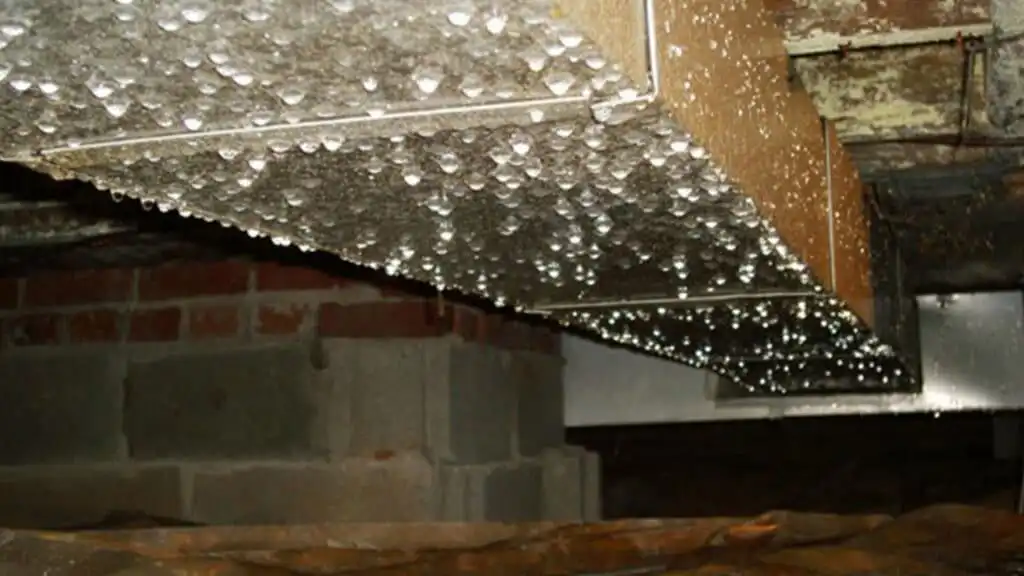
The core problem is straightforward. During Alabama and Georgia summers, the air outside a crawl space is warm and carries a heavy moisture load. When that air flows through the vents and enters the crawl space, it hits surfaces that are cooler than the outdoor temperature. Warm, humid air meeting a cooler surface doesn’t dry anything out. It condenses, and that condensation has nowhere to go.
What Happens in Summer
- Warm, humid outdoor air enters the crawl space through the vents
- That air hits cooler surfaces like floor joists, insulation, and the ground, causing condensation to form
- The crawl space doesn’t dry out between vent cycles because the next wave of humid air arrives before anything recovers
- Over a Southern summer, this process runs almost continuously
What Happens in Winter
- Cold air entering through open vents drops the crawl space temperature
- Warm air rising from the ground meets those cold surfaces and condenses in the same way
- There’s no season where venting reliably produces a dry crawl space in this region
What the Moisture Does Over Time
- Insulation absorbs moisture, sags, and loses its effectiveness
- Wood joists develop surface mold, then deeper rot if conditions persist
- Floors above the crawl space soften in spots or begin to feel uneven
- A persistent musty odor develops that spreads into the living areas above
By the time any of this is obvious to a homeowner, the moisture has usually been building for years. The vents didn’t cause the humidity, but they gave it a direct path inside and no reliable way out.
What Encapsulation Does Instead
Encapsulation takes the opposite approach from venting. Rather than trying to manage moisture by moving air through the crawl space, it eliminates the connection between the crawl space and the outdoor environment entirely. The goal is a sealed, conditioned space where humidity is controlled rather than exchanged.
Sealing the Space
- Crawl space vents are closed off and sealed, cutting off the pathway that brings humid outdoor air inside
- A heavy-duty vapor barrier is installed across the floor and up the walls, blocking ground moisture from rising into the space
- Access doors and any utility penetrations are sealed to prevent air infiltration from other entry points
Controlling What’s Left
- A dehumidifier maintains the humidity level inside the sealed crawl space within a stable range year-round
- Without a continuous supply of incoming humid air, the dehumidifier maintains conditions in a closed system rather than fighting a constant influx of moisture
- Drainage components can be added where water intrusion is a factor, directing any moisture that does enter toward a sump rather than letting it sit
What the System Protects Against
- Ground moisture rising through bare soil or an inadequate vapor barrier
- Seasonal humidity swings that venting cannot compensate for in a Southern climate
- The condensation cycle that damages wood, insulation, and air quality over time
Encapsulation changes the conditions that allow moisture problems to develop in the first place, which is why the results tend to hold up over the long term rather than requiring repeated intervention.
What Homeowners Actually Notice After Encapsulation
The musty smell that had worked its way into the lower level of the home fades once the moisture source is gone. Floors that developed soft spots or slight flex as joists absorbed moisture over time stabilize as the wood dries out. In winter, floors above a sealed crawl space feel noticeably warmer because the space is no longer exchanging air with the outdoors. These aren’t cosmetic changes; they’re signs that the crawl space is no longer actively working against the rest of the house.
Heating and cooling costs can also shift. Damp air takes more energy to condition than dry air, and a crawl space that had been pulling humid outdoor air into the home was quietly adding to that load. How much changes after encapsulation depends on the home and how long the moisture had been accumulating, but most homeowners notice the house holds temperature more consistently than it did before.
Schedule a Free Crawl Space Inspection
If your home has foundation vents and you’ve noticed musty odors, soft floors, or higher energy bills, the crawl space is the right place to start. SouthernDry has been protecting Alabama and Georgia homes since 2004, and every inspection is free with a written estimate and no obligation.
Every repair is backed by the Guaranteed Solutions for Life warranty, and there are no subcontracted crews.Schedule your free estimate and get a clear answer on what your crawl space needs.